
Remembering the Virtues
Love over Power

[Hello Substack Readers, as always, you are in my thoughts and prayers, and please know that I never take it for granted that you’re on this journey with me. I so very much appreciate it.
Today is a big day in the Birzer house. Child no. 4, Harry, turns 21 today. It’s been so amazing to see him grow from a clever kid into a serious adult. I’m incredibly proud of him. Also, child no. 3, Maria Grace, is celebrating the 15th anniversary of her taking her first communion.
Things have gone incredibly well for the release of my book, The Declaration of Independence: A Radical Experiment in Liberty. Over the first week, it’s been the no. 1 new release in Modern Western Philosophy at Amazon. I’ve also done (and loved doing) a whole series of podcasts and radio shows. I’ll share those as they become available online.
Also, I was able to get all the final edits done on Tolkien and the Inklings: Men of the West. It’s now going into page layout. The page designs look absolutely beautiful.
Ok, Substack Reader. That’s it for now. Again, I wish you nothing but the best! Yours, Brad
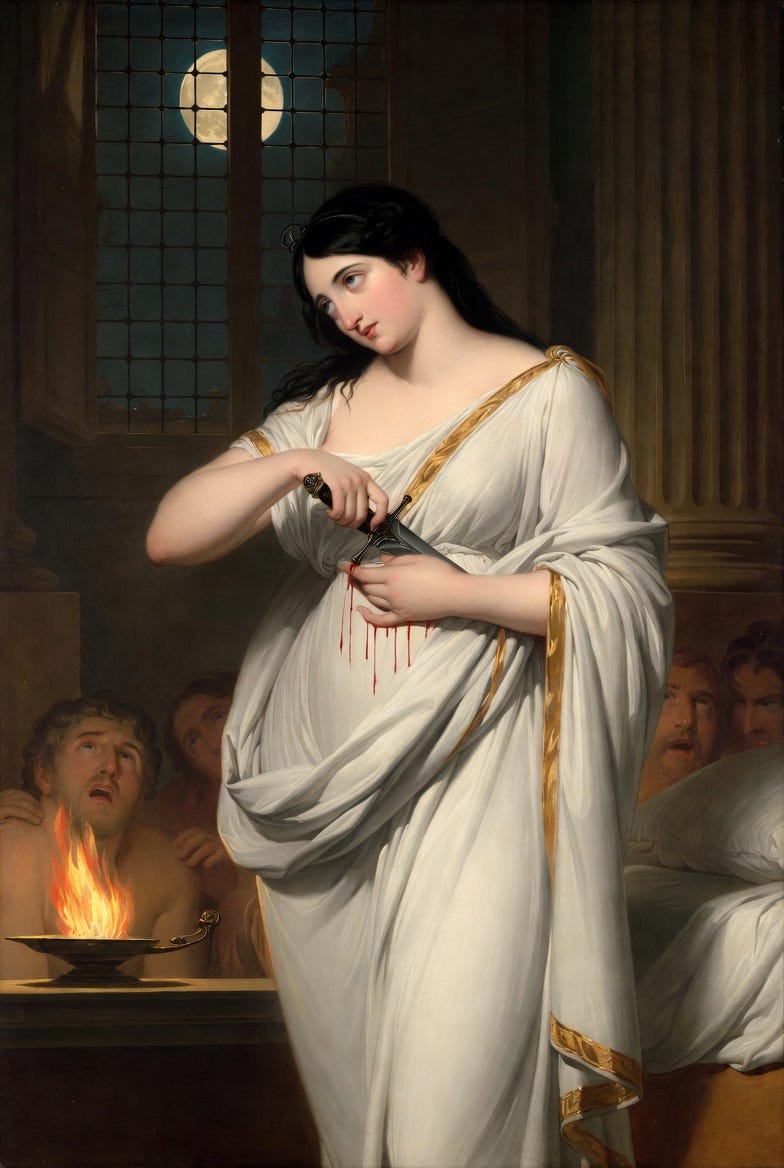
P.S. The image below is of the testimony of Lucretia, over whom the Romans rebelled against the Etruscans and established the Republic]
It was once true, unfortunately, that history was written by the victors. Now, it seems, we’ve gone terribly far in the other direction, and history, rather poorly, is written by the victims.
It’s not just our historians, I must admit, though academics as a whole contribute less than nothing to our society. After all, they care more about their own agendas and their own turf than they do about the common good.
As I look over social media, I see anger, emotion, more anger, sentimentality, victimhood, and even more anger. If social media is an accurate register, we have one very scary, atomized culture.
The same is true when I look at Washington, D.C. There, I also see anger, emotion, more anger, sentimentality, victimhood, and even more anger. But, I also see manipulation—manipulation of truth, manipulation of persons, and manipulation of the society. Imagine a group of people who have divided into two warring, Manichaean camps, each claiming to represent best the American republic, all the while diabolically pushing us into outrageous debt and social engineering.
And, the Church of the first quarter of the twenty-first century. . . well, let’s not even go near there. Enough said.
Where do we see the pursuit of virtue, or even the pursuit of the individual virtues, in any of this? Can most American politicos or academics even define virtue or name the virtues?
Most likely, the sad answer is no. Indeed, one must wonder when the word virtue—as a physical thing formed by the lips or as a concept flittering through the soul—has even arisen in the last several decades in our nation’s imperial city or in one of our ivy league schools.
I suspect that much of the neglect of virtue comes as much from its inconvenience for the powermongers as much as it does from its necessary reliance on free will. “Men will be good or bad builders as a result of building well or building badly,” Aristotle claimed. “For if this were not so, there would have been no need of a teacher, but all men would have been born good or bad at their craft. This, then, is the case with the virtues also.”Somewhat horrifically, though, for the last two-hundred years, western civilization, in particular, has moved steadily away from a belief in real choices and toward determinisms of various types.
The virtues, however, are rooted in nature, in creation, and in God’s will for us. They can be forgotten, mocked, or distorted, but, being real and true and beautiful, they can never be conquered. Russell Kirk argued that virtue “is [the] energy of soul employed for the general good.” Thus, there is never a bad time to remember the virtues, and our society desperately needs them. God distributes these, then, according to His Will, through His Economy of Grace. “For just as in a single human body there are many limbs and organs, all with different functions,” St. Paul wrote, “so all of us, united with Christ, form one body, serving individually as limbs and organs to one another.” Gifts such as teaching, counseling, or speaking “differ as they are allotted to us by God’s grace, and must be exercised accordingly.” Our gifts should be for the common good, for the Body of Christ–that is, the Church.
The Pagan Virtues
Prudence: the ability to discern good from evil.
Justice: to give each person his due.
Fortitude: to espouse the good, no matter the cost.
Temperance: to use the created goods only for good.
The Roman Virtues
Labor: to do one’s best and pursue excellence at and in any activity.
Fate: to accept one’s place in the order of things.
Piety: to praise those who came before us—divine and mundane.
The Christian Virtues
Faith: to believe in things unseen.
Hope: to believe one’s life has meaning and eternal existence.
Charity: to give of one’s self to another.
Clearly, many of the words employed for the virtues—such as prudence, temperance, and charity (love)—continue to hold great power in our society, but we have almost utterly perverted their meanings. We take prudence as timidity, temperance as abstinence, and love as lust. Each of these perversions is nothing short of a tragedy for the human person and for society.
Many of our greatest leaders have sought to remind us of the virtues. John Adams, certainly one of the greatest of the American Founding Fathers, argued that virtue is “a positive passion for the public good.” Further, it will serve as “the only Foundation of Republics.” In the Notes on the State of Virginia, Thomas Jefferson wrote unequivocally that virtue “is the manners and spirit of a people which preserve a republic in vigour.”
Long before the American founding, the great Roman Senator and republican Marcus Cicero espoused the virtues and decorum in his letters to his son, On Duties. One “must believe that it is characteristic of a strong and heroic mind to consider trivial what most people think glorious and attractive, and to despise those things with unshakable, inflexible discipline.” Furthermore, he stressed, one must “endure reverses that seem bitter” and “to endure them so that you depart not one inch from your basic nature, not a jot from a wise man’s self respect.”
Though we cannot bestow the virtues upon ourselves, we can—and should and must—pursue them in every activity of life: in family, in neighborhood, in church, in school, in business, and in government. We should teach them to our children, and we should encourage them in others. Indeed, just as we once demanded that each American child memorize the Declaration of Independence, we should do the same with the virtues. Ten terms and ten definitions—repeated, explained, and modeled—will eventually return them to common discourse and to the common good. After all, each one of the ten is true and, thus, as mentioned earlier, cannot be destroyed. We only have to remember them to reclaim the power they should and will wield.
Not the power of the mongers, but the power of the just.
To teach the virtues requires religion. And unfortunately the public schools have eliminated that annoying detail. Even the famous and widely used (until 1920s) McGuffey Readers were based on Christian values, even though not explicitly promoted.
Hi Brad, congratulations on your new books. Both have been added to my reading list.
God Bless, Mark